ISRG – Intuitive Surgical Inc. Bucket: Consistent Compounder . Financials current through: Q2 2026 (June 30, 2026) · Source filings: FY2024 and FY2025 10-Ks; 10-Qs for Q1–Q3 2025 and Q1–Q2 2026. Equity position – I’ve established a small position in this company as I believe long-term consistent compounders tend to be excellent managers of capital, as indicated by their ROIC and will add more if evidence emerges revenue accelerates.
Executive Summary
Intuitive Surgical sells da Vinci surgical robots and Ion lung-biopsy catheters, then earns most of its money from the instruments and service each procedure consumes. Recurring revenue was 85% of Q2’26 revenue.
The quarter. Revenue rose 19% to $2.89B, operating margin reached 33.6%, and da Vinci procedures grew 15%. U.S. procedure growth was 12%, the slower half of that number, and outside the U.S. 20%.
The moat. ROIC runs well above any reasonable cost of capital, and the source is switching costs: trained surgeons, hospital credentialing, and an installed base of ~11,710 systems, growing 12% a year. Verdict: wide, stable.
The open question. Intuitive says it anticipates extending instrument use limits in 2027, which lowers hospitals’ cost per procedure and, mechanically, Intuitive’s revenue per procedure. Management hasn’t sized it. The bet is that cheaper cases bring more cases. The 2020 version of the program was expected to save customers 9%–15% on affected instruments.
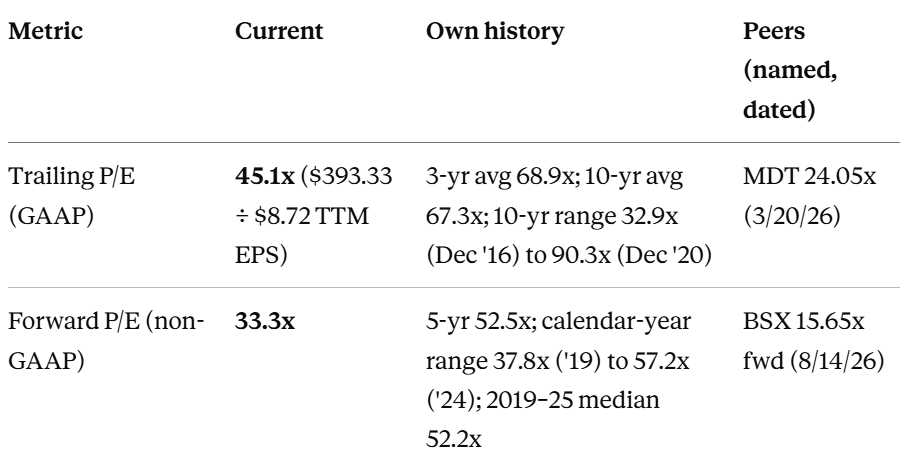
Valuation. Forward P/E of 33.3x is about 37% below its own five-year level of 52.5x and the lowest reading in seven years. The price requires growth to continue rather than accelerate, but it also requires the multiple to stop compressing. No peer is a true comparable, so the stock is measured against its own history.
Next checkpoint. Q3 earnings on October 20, 2026, when management has promised Extended Use Program detail.
1. The Setup
Intuitive is the player who has held serve for twenty years. What’s new in 2026 is that the server has started taking pace off the first serve on purpose. The company is lowering what a robotic procedure costs hospitals, betting that more rallies beat harder aces. The market had priced this stock near 70x earnings for most of a decade. It is now asking whether it’s watching a tactical adjustment or the first sign of a sore shoulder.
2. What They Do
Intuitive sells surgical robots and then sells the parts that wear out every time a surgeon uses one. Its two platforms are the da Vinci system, which lets a surgeon operate robotic arms from a console, and Ion, a robotic catheter that navigates deep into the lung to take biopsies.
The economics look like this:
- Systems sell for roughly $0.6M–$3.1M.
- Instruments and accessories bring in $900–$3,700 per procedure.
- Service contracts run $95K–$225K per system per year.
Recurring revenue (instruments, service, and lease payments) was $2.47B in Q2 2026, or 85% of revenue. More and more, Intuitive doesn’t sell the robot outright: 54% of Q2 da Vinci placements were operating leases, up from 49% a year earlier.
3. The Numbers, As Reported
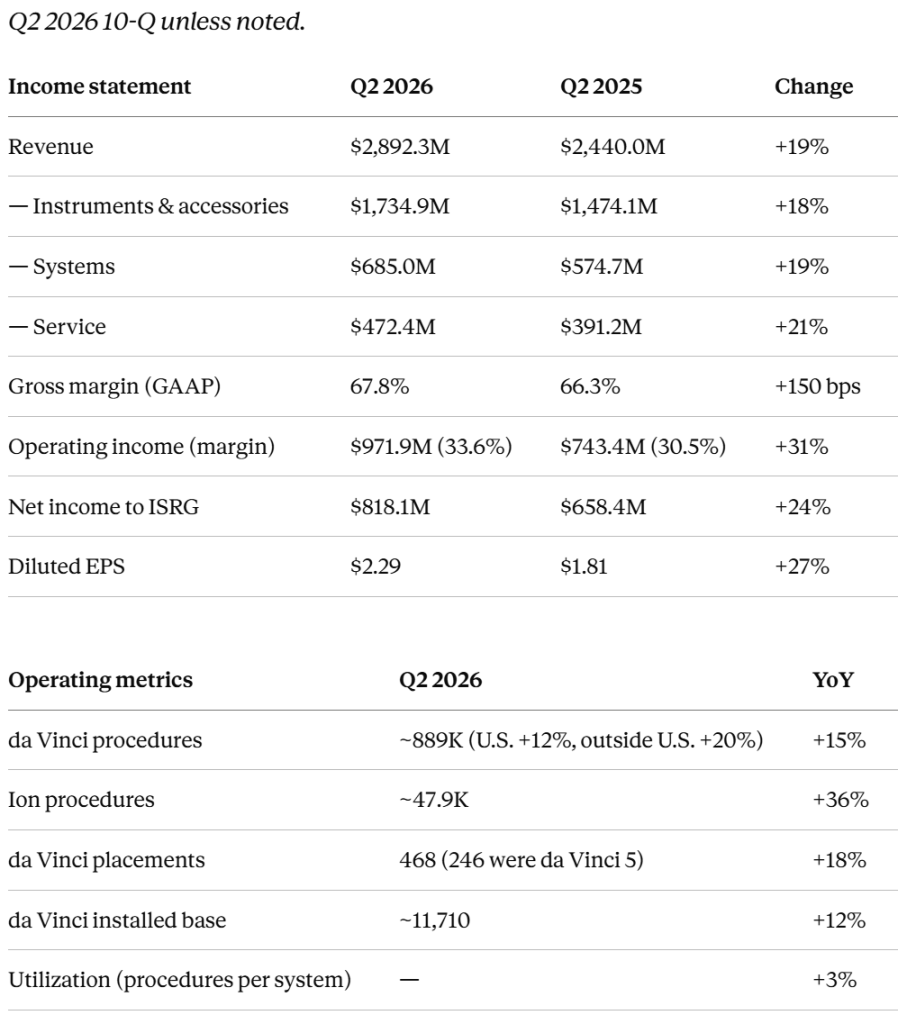
Thesis-critical number: gross margin. It beat, with a caveat. FY2025 was the trough at 66.0%, down from 67.5% in FY2024. The quarterly path since then is 64.7% → 66.3% → 66.4% → 66.4% → 66.1% → 67.8%. About 124 bps of the Q2 jump is a one-time tariff refund (see §9.2).
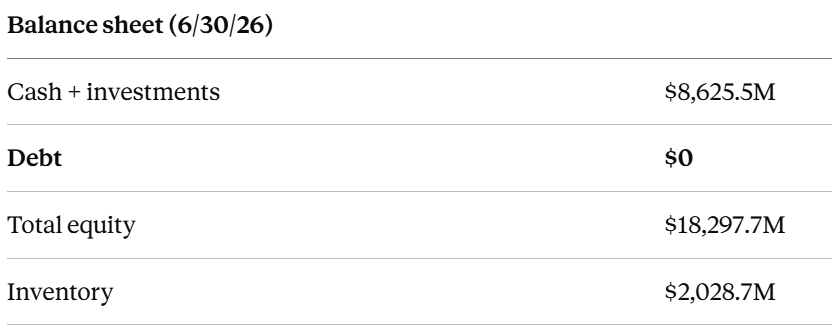
Debt, interest coverage, and coverage ratios: do not apply. The company has no borrowings. Instead of paying interest, it earns it: $82.7M of interest and other income in Q2. Its fixed obligations are $170.9M of operating leases and $2.53B of purchase commitments, most of which are cancellable purchase orders.
Cash flow: H1 2026 operating cash flow was $1,972.9M, less $215.9M of capex, for about $1,757M of free cash flow. On a trailing-twelve-month basis (TTM), free cash flow is roughly $3.22B.
Guidance (from the July 16 release, not the 10-Q): management held full-year da Vinci procedure growth at 13.5%–15.5%, expecting to land near the middle, and raised its non-GAAP gross margin outlook to 68%–69%. In short, the procedure guide was held and the margin guide was raised.
4. Strengths (bull case, evidenced)
- The installed base compounds on its own. 11,710 systems (+12%) with utilization up 3%, so volume grows without new sales.
- Operating leverage is visible. Revenue +19% turned into operating income +31%. SG&A fell from 23% to 21% of revenue.
- da Vinci 5 has a long international runway. There are 1,710 installed, but only 136 are outside the U.S.
- Ion is growing faster than its footprint. Procedures +36% on an installed base up 21%.
- Fortress balance sheet. $8.63B of cash and investments, no debt, and $4.7B left on a $5.0B buyback authorization.
5. Weaknesses / Risks (bear case, evidenced)
- Cyclical/policy-driven: U.S. growth is decelerating. U.S. procedures grew 12%, versus 14% a year ago. U.S. bariatric procedures fell high single digits, and management cites the expiration of enhanced ACA premium subsidies. (These were temporarily enlarged tax credits that lowered monthly premiums for people buying insurance on the Obamacare marketplaces; their lapse raises out-of-pocket costs, which leads some patients to postpone deferrable surgeries such as hernia and gallbladder procedures.) The U.S. is 67% of revenue. Management calls the impact “modest,” hasn’t quantified it, and it could reverse if Congress restores the subsidies.
- Structural, and a category change: price cuts are now a deliberate choice. The Extended Use Program for EndoWrist instruments is slated for H1 2027, aimed at lowering hospitals’ cost per procedure in high-volume benign cases. On the call, the CFO declined to size the impact and promised more detail next quarter. This shifts the story from “margin pressure happened to us” to confirmed deliberate pricing choice, the same reclassification seen with MPWR.
- Structural: the instrument aftermarket is under attack. The Q2 10-Q added an updated risk factor on third-party remanufactured instruments and unauthorized service.
- Structural: China. Q2 placements came in below plan because of domestic competition and a government governance campaign. China’s NHSA has also mandated a national pricing framework for robotic surgery that all provinces must implement in coming quarters.
- Cyclical: tariffs and hospital capital budgets. Tariffs cost $48.8M year-to-date, partly offset by refunds that remain under DOJ appeal. The filing also says customers are cautious about capital spending.
- Ion’s U.S. runway is narrowing. Management estimates U.S. penetration of lung biopsies is past the halfway point, and U.S. Ion placements fell from 47 to 42.
6. The Driver
Instruments and accessories: $1,734.9M, 60% of revenue, growing 18%.
That growth has two parts:
- Volume: about 15 points came from procedure growth.
- Revenue per procedure: the rest came from higher revenue per case, driven by da Vinci 5 and SP instrument mix.
Volume is the durable half. Revenue per procedure is the half at risk. Intuitive sells each instrument for a fixed number of uses, then the hospital buys a new one. In May 2026 the company said it anticipates raising the number of uses on certain core instruments in 2027 — the “Extended Use Program” — to lower hospitals’ per-procedure cost. More uses per instrument means fewer instruments bought per case, so Intuitive’s revenue per procedure falls unless volume rises enough to offset it. Management hasn’t sized the impact and says details are coming on the Q3 call [S16]. The 2020 version of the same program was expected to cut most U.S. customers’ costs on the affected instruments by 9%–15%. Model volume and revenue per procedure separately.
7. Who Else Is on the Field
The structure depends on the geography:
- U.S.: uncontested and monopoly-like.
- Globally: shifting toward “winning side of a contested fight.”
- China: already a multi-supplier rotation.
The 10-K names fourteen current or would-be competitors, including Johnson & Johnson, Medtronic, CMR, Medicaroid, and five Chinese manufacturers.
Third-party views disagree on how serious this is. These are analyst opinions, not facts from the filings:
- Morningstar’s analyst says Medtronic and J&J have now arrived as competitors, but still expects Intuitive to keep its dominance.
- Oppenheimer upgraded the stock in August, citing a lack of U.S. competition.
The filings themselves show no disclosed U.S. share loss and disclosed share pressure in China.
8. Moat + Margin Durability
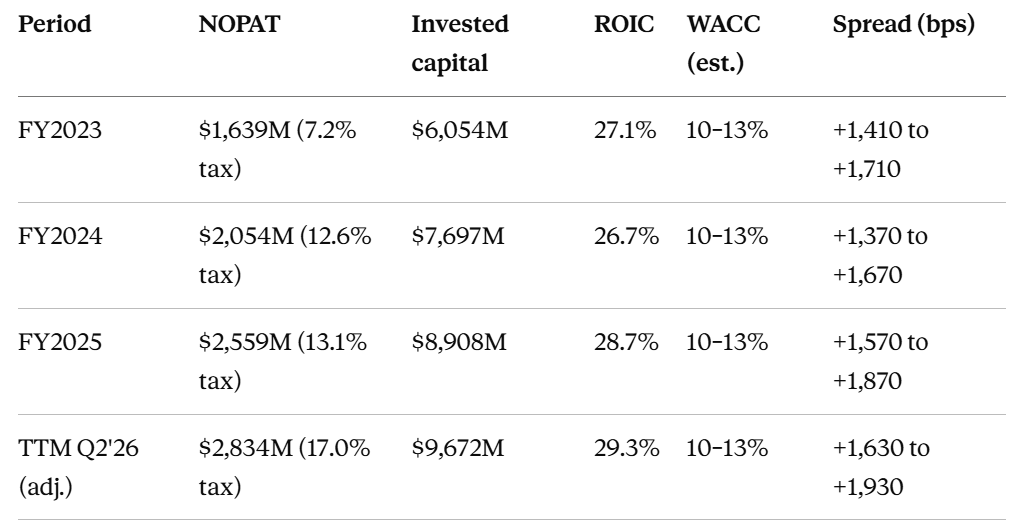
8.1 Quantitative core — ROIC vs. WACC
Inputs and conventions:
- NOPAT (after-tax operating profit) = operating income × (1 − effective tax rate).
- TTM operating income is $3,451.2M, less the $35.9M tariff refund from §9.2, which gives $3,415.3M adjusted.
- No other adjustment is needed. Operating income excludes investment gains, and the company has no warrant or settlement income.
- Invested capital = equity − cash and all investments (debt is zero). I use this instead of the template’s “cash & equivalents only” convention. The reason: the $5.9B of short- and long-term investments is Treasuries and money-market funds, not operating capital. Both conventions are shown below.
WACC (estimate). With no debt, WACC equals the cost of equity.
- Risk-free rate: the 10-year Treasury was 4.79% on September 2, 2026 [S11].
- Beta: the reported beta is 1.46 [S1], which is inflated by this year’s de-rating. I use a range of 1.1–1.46.
- Equity risk premium: 4.5%–5.5%.
- Result: 4.79% + (1.1 × 4.5%) = 9.7% at the low end, and 4.79% + (1.46 × 5.5%) = 12.8% at the high end. Estimate: 10%–13%.
Sensitivity checks:
- Template convention (subtract cash & equivalents only): ROIC is 15.4% / 14.2% / 17.6% / 18.2%. At the top of the WACC range, the FY2024 spread shrinks to about +120 bps. The spread stays positive under every combination tested, but its width swings from ~1 to ~19 points depending on convention. That is a finding, not a rounding issue.
- Tax rate: the effective rates above are held down by stock-comp tax benefits. At a normalized 21% rate, TTM ROIC is about 27.9%, so the conclusion doesn’t change.
Width: Wide. The duration claim rests on three things:
- An installed base of 11,710 systems tied to five-year service contracts.
- Regulatory clearance earned one procedure and one country at a time.
- A spread large enough to halve and still clear WACC.
The current spread is arithmetic. The 20-year duration is a judgment, defended in 8.3.
8.2 Moat Source
- Primary: high switching costs. Surgeon training, sunk capital, and five-year service contracts that the 10-K says “have generally been renewed.” A competitor’s price advantage has to overcome retraining a whole surgical program.
- Secondary: intangible assets. More than 5,600 granted patents and 2,500+ pending, plus procedure-by-procedure, country-by-country clearances (the filings list dozens obtained since 2024).
- Tertiary: cost advantage. Vertically integrated manufacturing at scale, which shows up as a 31% TTM operating margin.
Cross-check against §7. Switching costs are consistent with the U.S. being uncontested. They are not consistent with China, where the buyer (the state) runs a quota-and-tender rotation. The resolution: the moat is geographic. It’s wide in the U.S. and Europe, narrow-to-none in China. China is a small share of revenue, so the consolidated verdict holds.
8.3 Erosion, expansion, and what’s holding the margin
Erosion mechanisms:
- Remanufactured instruments: already live, and now an updated risk factor.
- China pricing caps: rolling out over the next several quarters.
- Aftermarket antitrust: the Larkin trial is set for September 14, 2027.
- The Extended Use Program itself: starting H1 2027.
Margin defensibility: the margin is protected by switching costs, not by financing or temporary supply constraints. But its level is increasingly a management decision, and management has announced it will spend some of it. A margin held by choice is a decision, not a moat. The moat keeps customers; management decides how much of that it monetizes.
8.4 Verdict
- Width: Wide.
- Direction: Stable. The deciding variable is revenue per procedure after the Extended Use Program, which is the monetization of the primary moat source (switching costs).
9. Reading the Fine Print — Forensic Read of the Filing
9.1 Share structure & dilution
- Structure: single share class, one vote, 353,278,038 shares outstanding as of July 16, 2026. No preferred shares issued, no convertibles, no warrants.
- Share count is shrinking: 356.6M (Dec ’24) → 355.1M (Dec ’25) → 353.9M (Jun ’26).
- Buybacks vs. stock comp: H1 buybacks of $1.44B were about 3.4× H1 stock comp ($419M). The gap between basic and diluted shares is 0.9%.
- Insider activity: five Rule 10b5-1 plans (pre-scheduled trading plans) were adopted May–June 2026. The largest is Executive Chair Gary Guthart’s, covering up to 107,596 shares plus 47,234 from a trust. All were adopted in open trading windows. They coincided with a change in the Chief Commercial Officer role and share-price weakness. That is worth noting, but it doesn’t signal anything by itself.
9.2 Quality of earnings
- The tariff refund: Q2 included $35.9M of IEEPA tariff refunds booked against cost of revenue, worth 124 bps of gross margin. Excluding it, Q2 gross margin was about 66.6% versus 66.3%, so only ~30 bps of real expansion. Management’s own non-GAAP figures agree: 70.0% reported, 68.7% excluding the refund [S4]. The refunds are gain contingencies, and the DOJ has appealed the refund order. They are real cash, but not a run-rate.
- Tax distortion: the effective tax rate was 8.8% in H1’25 and 17.3% in H1’26. Stock-comp tax benefits fell from $178.3M to $90.6M, and those benefits shrink when the stock price falls. Pre-tax income grew 33%; net income grew 21%. The business grew faster than headline EPS suggests.
- Deferred taxes: $370.3M of H1 tax expense was non-cash.
- Noncontrolling interest: 99.4% of net income belongs to ISRG shareholders, so there’s no SYM-style gap between headline and attributable earnings.
- Clean: no cash-flow reclassifications, no material weaknesses, and internal controls were concluded effective.
9.3 Related parties & concentration
- China joint venture: owned 60% by Intuitive and 40% by Fosun Pharma, and consolidated. Fosun is at once a partner, a minority owner, and the channel into China.
- No officer or director transactions are disclosed.
- No concentration: no customer, and no country other than the U.S., is 10% or more of revenue.
- March 2026 distributor acquisition: Intuitive bought its Italian, Spanish, and Portuguese distributors for $533.1M, netting $32.6M of receivables those distributors owed it, at fair value with no gain or loss. The treatment is clean.
9.4 Contingent liabilities — all allegations, one vacated finding
- SIS (antitrust): Intuitive won at trial in January 2025. The appeal was argued June 25, 2026, and a ruling is pending.
- Larkin hospital class action: in 2024 the court ruled Intuitive held monopoly power in the EndoWrist repair aftermarket. It vacated that ruling on reconsideration on July 30, 2024. Treat any secondary coverage quoting the “monopoly” finding as out of date. The class was certified March 2025, and trial is set for September 14, 2027.
- Restore Robotics: dismissed November 2025 and now on appeal.
- Product liability: accrued for. The company says a loss beyond the accrual is reasonably possible but can’t be estimated.
- Off-balance-sheet: no significant arrangements, and no going-concern language.
9.5 Segment & geography
Intuitive reports one segment, so no footnote can contradict the MD&A narrative. It also means there’s no profitability data by product or region. Several bear arguments (China margins, Ion economics) can’t be tested from the filings.
Sourcing is disclosed in detail:
- Instruments are made in Mexicali, Mexico, and mostly qualify for USMCA tariff exemption.
- Endoscopes are made mostly in Germany and are tariffed.
- Some raw materials come from China, and Chinese rare-earth export restrictions are named as a risk.
9.6 Auditor
PwC, the auditor since 2014, with no change. It issued unqualified opinions on both the financial statements and internal controls. The one critical audit matter is how standalone selling prices are set in bundled system contracts. That is appropriate for a hardware-plus-service business and is a recurring matter, not a new one. No accounting policy changes shifted reported numbers.
9.7 Verdict
Clean filing with minor noted items. The two items to carry into valuation are the tariff-refund boost to margin and the tax-rate distortion of EPS comparisons. There is no red flag and no reason to withhold capital on filing quality.
10. Valuation — Entry/Exit Framework
10.1 Snapshot
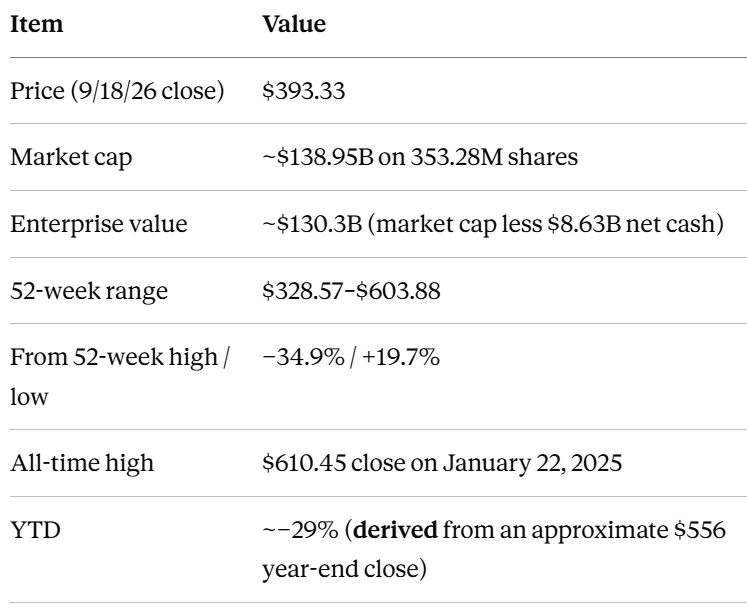
Why the drawdown happened: name-specific. Shares fell more than 12% in pre-market trading on July 17 after the company held rather than raised its procedure forecast and flagged demand-related changes. §9 is clean, so this is a reset of growth expectations, not a disclosure problem.
10.2 Multiple Panel
10.3 What’s Priced In
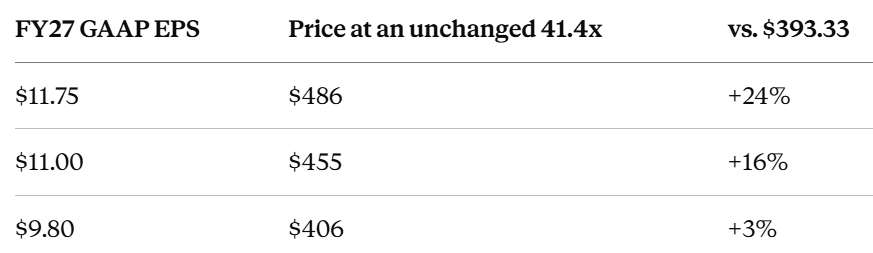
What’s priced in now. The market has already marked down the growth assumption. The forward multiple sat near 52x on average for five years and is 33x today, its lowest reading since before 2019 (§10.2). Morningstar’s PEG tells the same story: 3.22 now versus a 3.79 five-year level. What 41x GAAP still requires is that the business keeps converting 13.5%–15.5% procedure growth into high-teens or better EPS growth, that gross margin holds near 68%–69%, and that the Extended Use Program trades revenue per procedure for enough extra volume to be roughly neutral. That’s a demand for continuation, not acceleration — but it is not a low bar, and it assumes the de-rating stops here.
What the business has actually been delivering, for comparison: GAAP diluted EPS grew 18.8% in Q1’26 ($2.28 vs. $1.92), 26.5% in Q2’26 ($2.29 vs. $1.81), and 22.8% in H1’26 ($4.57 vs. $3.72), with the H1 rate held down by a higher tax rate (§9.2). Revenue grew 20.5% in FY25 and 17.2% in FY24.
What holds the multiple. If the multiple simply stays at 41.4x, the stock returns whatever earnings do. Nothing else. On FY27 EPS that means:
What expands it. A re-rating has to be earned by removing a specific doubt, and there are three candidates, all checkable: U.S. procedure growth re-accelerating above 14% (it was 12% in Q2’26), management sizing the Extended Use Program hit at ~3% or less with a credible volume offset on the October 20 call, and non-GAAP gross margin holding above 68% for two quarters without tariff refunds doing the work.
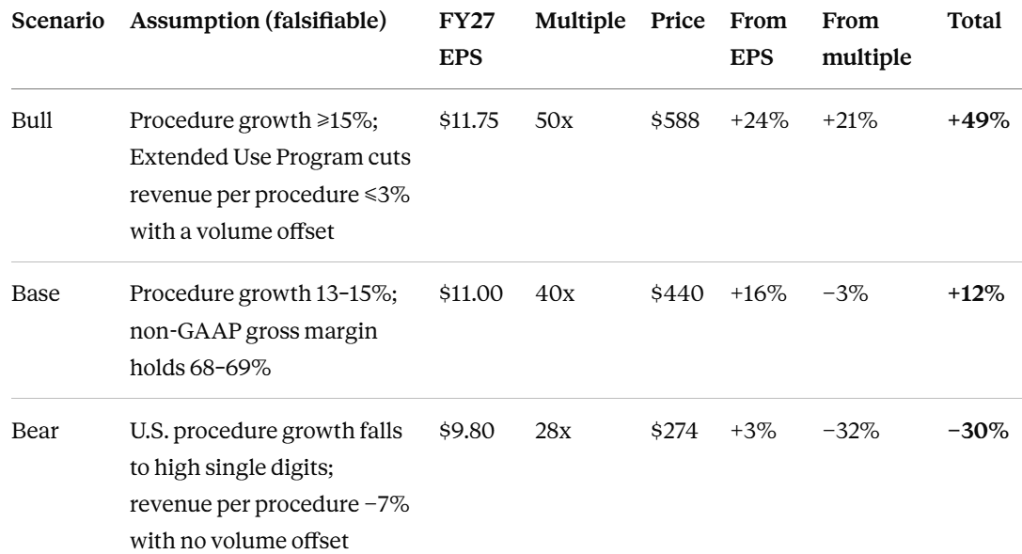
Scenarios, split into the two things that move the stock:
10.5 Historical context
Cheap versus itself, and still expensive in absolute terms. At 45.1x trailing earnings, the stock is about a third below its ten-year average P/E, roughly the 10th–15th percentile of its own decade. In absolute terms, it’s still a price that demands years of compounding.
10.6 Entry framework
Build small positions to monitor the stock at current prices. Wait for the Oct 20th call to verify/falsify any of the above. Add more on confirmation of procedure growth re-accelerating. If status quo remains, maintain position and wait for next point of verification. Otherwise, dump and move on.
11. What Would Change the Read
11.1 Patterns at work
- Hype-cycle position: the narrative is running behind the proof points. Revenue grew 19% and operating income 31%, yet the stock fell 12% on the print. The October 20 call confirms or refutes this.
- Regulatory dependency: diffuse, not binary. The gates are China’s NHSA pricing rollout, EU certification for da Vinci 5 force feedback (pending), and Japan’s next reimbursement cycle in April 2028.
- Macro regime: ACA subsidy expiration hitting deferrable benign procedures, plus hospital capital caution. This agrees with §10.6’s explanation of the drawdown.
- Does not apply:
- Financial engineering: no debt, no convertibles, and a shrinking share count.
- Founder-control structure: one share, one vote.
- Story-stock base rate: the company earns $3.1B of net income.
11.2 Bull/Bear Cases
- Bull case breaks if: U.S. procedure growth runs below 8% for two quarters, or revenue per procedure falls more than 7% after the Extended Use Program launches with no volume response, or installed-base growth drops below 8%.
- Bear case breaks if: U.S. procedure growth re-accelerates above 14%, or management sizes the Extended Use Program impact under ~3% with a credible volume offset, or non-GAAP gross margin holds above 68% excluding refunds for two straight quarters.
- Next catalyst: Q3 earnings on October 20, 2026. Management has promised Extended Use Program detail on that call.
12. The Close
The server hasn’t been broken in twenty years, and the ROIC math says the serve is still one of the best in the game, clearing its cost of capital by fifteen points or more. What’s changed is that the player has chosen to take pace off it, won’t yet say how much, and is waiting on an umpire’s ruling about whether opponents can play with remanufactured balls. The crowd has already repriced the ticket from 70x to 45x. The set score is still 5–1. The next game starts October 20.
Disclosure
I own a small position in Intuitive Surgical (ISRG), established before this post was written. I may add to it, trim it, or sell it at any time without updating this page. Nothing here is investment advice or a recommendation to buy or sell any security, and it isn’t tailored to anyone’s circumstances. I have no business relationship with Intuitive Surgical or any other company named here, and I received no compensation from any of them. Everything above is drawn from public sources — primarily Intuitive’s SEC filings, plus the third-party data listed in the source key — and reflects what those sources said as of September 21, 2026. Figures marked as derived or estimated are my own calculations and may be wrong. Do your own work before risking your own money.


Leave a comment