*Disclosure:* I own shares of Monolithic Power Systems (NASDAQ: MPWR). Nothing here is financial advice. Full disclaimer at the end.
Quick Take
Back in November 2024, I wrote up MPWR after Edgewater Research put out a note claiming Monolithic was losing share in NVIDIA’s Blackwell GPUs. The stock had dropped ~15% in a day to $674, and I argued the long-term thesis looked intact. About twenty months later, it’s worth revisiting that view honestly rather than declaring victory. Two things have happened: MPWR has re-won a large share of NVIDIA’s next-generation Vera Rubin power sockets (reportedly ~70%) and was first to sample 800V VDC solutions — and the stock has re-rated to the $1,300–1,500 range, which raises its own set of questions. The business has executed, and the July 30 Q2 print was the strongest evidence of that yet. But execution and a good entry price are different things. The valuation, the deepening data-center mix, and a couple of governance items mean this is not a simple “it worked, buy more” story. Below is the balanced update, including what I got right, what has changed, and where I’m now more cautious.
What’s Changed Since My Last Post
The MPWR of late 2024 was a diversified analog power-chip company with a promising AI-server angle and a scary headline. The MPWR of mid-2026 is something more specific: an AI-infrastructure power name whose fortunes are now tightly bound to the data center. That’s both the bull case and the thing to watch.
One development stands out. The 2024 Edgewater note claimed Monolithic was being designed out of Blackwell. What followed fit the pattern I described at the time: in a multi-generation design cycle, a supplier that loses a socket often re-competes for the next one. By early 2026, MPWR had reportedly re-won roughly 70% share of Vera Rubin and was first to sample the 800V DC architecture NVIDIA’s next-generation racks require, and several analysts raised their estimates of MPWR’s role as a Vera Rubin power supplier. That’s a favorable outcome — but I’d stress the flip side, because it’s the more important lesson: the same contested-socket dynamic that allowed the recovery is exactly what makes any single win temporary. More on that in the Moat section.
Q2 2026 Results: Sequential and Year-over-Year
MPWR reported Q2 2026 after the close on July 30. It was a beat on both lines and a substantial raise on the next quarter.
The headline numbers:
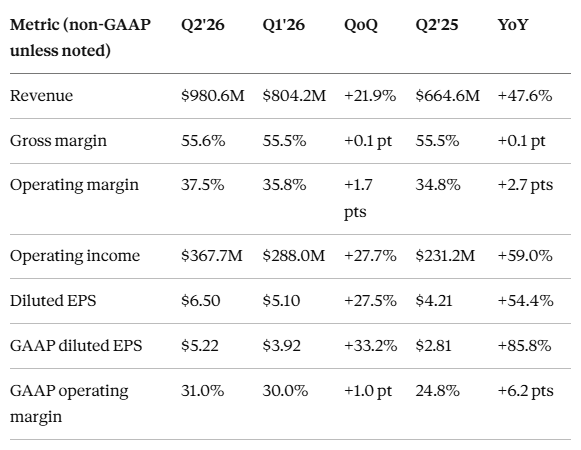
Consensus was roughly $903 million in revenue and about $5.88 in non-GAAP EPS, so this cleared the bar by a wide margin on both. Worth a deeper look, because the sequential and year-over-year stories are not identical, but they are complementary.
The sequential story is breadth. Every one of the six end markets grew Q/Q — Enterprise Data +44.8%, Communications +18.0%, Storage & Computing +14.6%, Industrial +12.7%, Consumer +4.2%, Automotive +3.1%. That is a meaningful change from the Q1 picture I described, when the traditional segments were flat-to-shrinking while data center carried the whole company. Management’s framing — “the strength of our diversified model” — is fair on a sequential basis.
The year-over-year story is concentration. Enterprise Data revenue rose 164.3% to $380.6 million and now represents 38.8% of the business, up from 32.7% in Q1 and roughly 22% a year ago. Communications grew 78.3% YoY. Against that, Storage & Computing grew just 2.3% YoY, Automotive 8.2%, and Consumer declined 4.8%. Automotive’s share of revenue fell from 18.9% to 16.0% not because it shrank, but because it couldn’t keep up. The base is healthier than it was in Q1, and the mix is nonetheless more AI-dependent than it was a quarter ago.
Margins. Non-GAAP gross margin came in at 55.6%, up a tenth of a point sequentially and a tenth year-over-year — still at the low end of the company’s 55–58% model, and still the least impressive line in the release. But the operating leverage is real: non-GAAP operating margin expanded 1.7 points sequentially and 2.7 points year-over-year, because revenue grew 21.9% while non-GAAP operating expenses grew 12.1%. That is the whole argument for operating leverage. GAAP operating margin improved even more sharply, from 24.8% to 31.0% Y/Y.
Guidance. Q3 revenue guided to $1.14–1.16 billion, roughly 17% above the ~$987 million analysts were modeling and implying about 56% year-over-year growth at the midpoint. Non-GAAP gross margin is guided to 55.4–56.0%. That guide deserves attention for a specific reason: management had flagged potential second-half gross-margin headwinds on the Q1 call. The Q3 guide does not show them. That’s a genuine positive, but “not yet visible in one quarter’s guidance” is not the same as “resolved” – I’m cautious heading into Q4 with what’s happening on the macroeconomic side (e.g. Iran war, stubbornly high energy prices, possible interest rate increase).
Balance sheet and inventory. Cash and short-term investments rose to $1.41 billion from $1.37 billion. Operating cash flow was $227.9 million, down from $250.3 million in Q1 as working capital absorbed growth. The inventory line I flagged last time improved: days of inventory fell to 140 from 157 on current-quarter revenue, and to 121 from 128 measured against next quarter’s projected revenue. Absolute inventory did rise to $675.8 million from $619.2 million, but it’s being consumed faster than it’s building, which is the right direction. The board also added $500 million to the buyback authorization, bringing the total to $1 billion. Buybacks are typically a strong vote of confidence in ability to continue to perform.
Two other items from the release worth carrying forward: the company extended its capacity goal significantly beyond $6 billion (that target itself was raised from $4 billion only one quarter ago), and it received initial orders for high-speed DDR5 memory components, which had been at the sampling stage in Q1. Both are covered below.
For readers who owned this for the “consistent compounder with an AI angle” thesis, the AI angle is now unambiguously the dominant driver rather than a side story — which is a change in the risk profile, not just an acceleration of the old one.
The Business (briefly), for New Readers
For anyone who didn’t read the 2024 write-up: Monolithic is a fabless analog/mixed-signal semiconductor company — it designs power-management chips and outsources the manufacturing, which keeps capital expenditures low and lets it pour resources into R&D. Its edge, as I explained last time, is right there in the name: “monolithic” refers to integrating all the components onto a single piece of semiconductor via its proprietary BCD (bipolar-CMOS-DMOS) process, delivering higher power density and configurability than multi-component solutions. That translates into reliability, space savings on a crowded server board, and high switching costs.
What’s new is where that capability is being applied. The highest-value growth is now power delivery for AI servers and GPUs — vertical power delivery, 800V architectures, the plumbing that lets hyperscalers pack more compute into a rack within thermal limits. Founder-CEO Michael Hsing (with the company since 1997) is still at the helm. Long CEO tenure has historically been part of the case for MPWR, though as I note below, leadership continuity is a positive to weigh against the governance items that surfaced this year, not a substitute for scrutinizing them.
Why Power Density Matters in a Power-Constrained World
If there’s one part of the thesis I’d give more weight to than I did in 2024, it’s this. The constraint on AI isn’t only the number of chips — it’s getting enough clean, efficient power into them, in a fixed physical space, without generating heat you then have to spend more power removing. Every new GPU generation draws more current through the same or smaller footprint. That is a physics problem before it is a spending problem, and it’s precisely the problem MPWR’s integrated power ICs and modules exist to solve.
This connects to a macro trend I’ve written about elsewhere: power is becoming a genuine bottleneck. Grid upgrades lag demand, data-center electricity draw is climbing, and utility rates are rising for everyone. In that environment, efficiency is not a nice-to-have — a power-delivery solution that wastes fewer watts and takes less board space has quantifiable value to a hyperscaler measured in megawatts and rack density. MPWR’s push toward higher-voltage architectures and its shift from selling discrete chips to selling integrated power modules are both bets on this: that as power gets scarcer and denser, whoever delivers the most efficient watt-per-square-millimeter earns pricing power.
Q2 gave that argument two concrete data points. First, MPWR began sampling High Voltage AC-to-DC products for 800V data center architectures, explicitly described as expanding beyond its current AI and server core power solutions. That matters more than it sounds: core power is the socket MPWR already competes for. AC-to-DC front-end conversion is a different, adjacent piece of the rack — moving up the power chain rather than defending the same position. If the 800V transition happens as the industry expects, the addressable content per rack goes up, not just the share of an existing socket. Second, on the underlying process technology, Hsing described the BCD roadmap moving from roughly 60nm toward 40–45nm specifically to increase power density — his own framing being that this is the same thing MPS has done for twenty years, just executed better than competitors. That’s the engineering underneath the headline design wins.
I’d stress two cautions. First, this is a structural tailwind, not a moat by itself — competitors (Texas Instruments, Analog Devices, Infineon, and specialist GaN/SiC players) are chasing the same physics, so execution and being-first still decide who wins each socket. Second, the payoff is not all near-term: management has indicated the 800V data-center opportunity won’t contribute meaningful revenue until roughly late 2027, and Q2’s news was sampling, which is the first step of that multi-year path rather than a shortcut through it. So I treat power density as the most durable reason to own MPWR over a long horizon, while being clear it’s a multi-year story rather than a next-quarter catalyst.
Product Line Diversity — Real Vectors, Now With Evidence
This is where Q2 changed my read the most, so I want to be careful in both directions.
In Q1, the honest description was that MPWR was getting less diversified: Enterprise Data was expanding while notebook, consumer, and storage went flat or shrank. Q2 complicates that in a good way. All six end markets grew sequentially. Storage & Computing added $25 million quarter-over-quarter on memory and storage power management. Industrial grew 12.7%. Even Consumer, the weakest line in the book, grew 4.2% sequentially. A quarter in which the entire portfolio moves up together is materially better evidence for the diversified-model claim than a quarter in which one segment carries everything.
But diversity of product line and diversity of revenue mix are two different measurements, and only one of them improved. On a mix basis, Enterprise Data went from 32.7% to 38.8% of revenue in a single quarter. On a year-over-year basis, four of six segments grew at or below 20% while data center grew 164%. So the company is genuinely selling into more places than it used to; it is also, at the same time, earning a larger share of its revenue from one place than it used to. Management’s diversification framing is defensible. but not the whole picture. We’ll have to see the numbers support it.
Where I do think the forward case is strengthening is the design pipeline, which is what “diversity” actually means over a multi-year horizon. Hsing runs what he calls the standard MPS playbook — engage broadly, win as many sockets as possible across end markets, accept that many ramps are years out. Several vectors moved in Q2:
– Communications is no longer a one-quarter blip. It grew 33% sequentially in Q1 and another 18.0% in Q2, and is up 78.3% year-over-year to $131.5 million on power solutions for optical modules and switches. This is a second AI-adjacent leg, distinct from server core power. It’s now 13.4% of revenue.
– Automotive grew only 3.1% sequentially and 8.2% year-over-year, and its revenue share fell to 16.0%. The forward-looking number is better than the reported one: MPS has shipped products into over 1,500 new automotive sockets so far this year, expanding its footprint in ADAS and other in-vehicle applications. Auto design wins ramp on multi-year cycles, so this is a real pipeline datapoint that simply won’t show up in revenue for a while.
– DDR5 high-speed interface products moved from sampling at a major customer in Q1 to initial orders in Q2, with management expecting the segment to expand its served market into next year. That’s the fastest-moving of the new adjacencies and the one I’d watch first for evidence the playbook converts.
– Robotics, including humanoids — designs across battery management, compute power, and actuators. Management has been candid that 2026 volume is low and hard to predict. Still optionality, not an earnings driver.
– Capacity was extended significantly beyond the $6 billion goal set only one quarter ago (itself up from $4 billion). Capacity targets are a statement about expected demand across the whole product line, not just data center — though they’re also just targets, and the company is now revising them at a pace that deserves to be tracked rather than simply applauded.
The honest synthesis: MPWR’s end-market ambition is widening and Q2 provided the first quarter of broad-based evidence that it isn’t only ambition. Its near-term revenue is still concentrating into AI data center. The pipeline supports the long-term case; it doesn’t offset the near-term concentration risk yet. What Q2 changed is that the pipeline stopped being purely a story and started producing sequential growth in the segments it’s supposed to feed.
Moat — And Its Limits
This is where I’d revise my 2024 write-up most, because owning MPWR has clarified the shape of its moat.
The moat is real: reference-design lock-in (once designed into a platform, a supplier is sticky for that generation), power-density and efficiency engineering IP, the chip-to-module transition that raises switching costs, and long-tenured technical leadership. High returns on equity and invested capital, low debt, and premium pricing held through a hypergrowth phase — those strengths still hold, and Q2’s operating-margin expansion is fresh evidence for the pricing-power piece.
But note the phrase “sticky for that generation.” MPWR’s moat is generational, not permanent — largely by design of its biggest customer. NVIDIA deliberately keeps multiple qualified power suppliers competing on each new chip generation. That’s why the Blackwell scare happened in 2024, and it’s why the Vera Rubin win, favorable as it is, isn’t something a shareholder can extrapolate indefinitely. MPWR is a strong competitor gaining share in a contested category, not an unassailable monopolist. It has re-competed for sockets effectively — but it has to keep doing so, cycle after cycle. That contested-socket dynamic is, in my view, the single most important thing to understand about this company. It cuts both ways: it created the 2024 dislocation, and it’s the reason MPWR can’t be treated as a set-and-forget holding.
The 800V AC-to-DC expansion is the most interesting counter-argument to this, and I’d hold it loosely for now. Broadening from core power into adjacent rack power means competing for more sockets, which raises the ceiling — but it also means competing in more contested categories, not fewer. Widening the fight is not the same as ending it.
Risks
I flagged China exposure as the top risk in 2024. It’s still there, but the risk profile has broadened and I want to be straight about all of it:
– Contested-socket cyclicality. Covered above — the moat is generational. A future design loss on a major platform is always possible, and the market will punish it hard given the valuation.
– Data-center concentration. Enterprise Data is now 38.8% of revenue, up from 32.7% a quarter ago and roughly 22% a year ago. Q2’s across-the-board sequential growth genuinely softens this concern relative to Q1, and the automotive and DDR5 pipelines may ease it further over time. But the mix is still narrowing, and the single largest driver of the business is now a capex cycle MPWR does not control.
– Margin. Non-GAAP gross margin has now sat in the 55.5–55.6% band — the *low* end of the company’s 55–58% model — for five consecutive quarters. The Q3 guide of 55.4–56.0% doesn’t show the second-half headwind management flagged in April, which is encouraging, but Q4 is where that caution was actually aimed. Operating margin is doing the heavy lifting; gross margin is not yet participating.
– Valuation. This is the part I’d weigh most heavily. Shares closed near $1,318 ahead of the print and traded up roughly 10% to about $1,447 in the after-hours reaction. Pre-print consensus was around $24.18 for 2026 and $29.85 for 2027; those will be revised upward after this beat and raise, and my own arithmetic off the Q3 guide implies roughly $7.60–7.70 in non-GAAP EPS for the quarter, putting the full year on pace for the high $20s if Q4 holds. Even on that revised basis the stock is somewhere in the neighborhood of 50x forward earnings, with the trailing multiple considerably higher. That’s a price that requires the growth to keep arriving. The good news is earnings are now growing into the multiple; the caution is that this is precisely the setup where a single missed quarter costs 20%.
– Elevated inventory — improving. Days of inventory fell to 140 from 157 (and to 121 from 128 against next quarter’s revenue). Absolute inventory still rose to $675.8 million. Better than last quarter, still a line to watch if ordering reverses.
– A restatement worth understanding, not fearing. In February 2026, MPWR’s Audit Committee filed an Item 4.02 notice determining that its FY2024 audited statements and its 2025 interim statements should no longer be relied upon, and restated them for a ~$195 million non-cash deferred-tax error tied to the accounting for a one-time foreign tax incentive. The details matter: the company self-identified the error while preparing its 2025 10-K, disclosed it promptly, stated explicitly that there was no misconduct, and the adjustment did not touch revenue, gross margin, or any non-GAAP operating metric. So this is a controls-and-governance blemish on a company I’ve praised partly for its discipline, not a cash problem or a sign of operational trouble. One update: the Q2 release’s risk factors still reference the company’s ability to timely and adequately remediate its material weakness, so this is not fully closed out yet. I’d like to see that language disappear.
– Insider selling — with context. Form 4 filings continue to show a one-way pattern, with additional insider transactions filed as recently as mid- and late-July 2026 and no open-market purchases. Taken raw, that reads as a red flag. But context matters: a meaningful chunk of the early-2026 selling was executed under a pre-arranged Rule 10b5-1 plan, and some was RSU tax-withholding — the least signal-laden kind of sale. The fairer way to hold it: after a run of this size, insider diversification is normal, but no insider has bought in the past year, and that absence of buying is the part I keep an eye on rather than the routine planned sales. The new $500 million buyback authorization is at least the company itself signaling the opposite view.
Where I Land
In 2024 I said that, absent a dramatic change in leadership, I expected MPWR to keep compounding. Leadership hasn’t changed and the business has executed — Q2 was the cleanest quarter I’ve seen from this company, with a large beat, a substantially raised guide, expanding operating margins, improving inventory, and every end market growing at once. I want to give that its due rather than reflexively hedging it.
I also want to resist treating it as vindication, because the setup today is different from the one I was underwriting then. The quality that made MPWR attractive on the 2024 dislocation — the contested, back-and-forth nature of these NVIDIA sockets and the sharp moves on a single analyst note — is in tension with owning it as a durable, low-maintenance compounder. A position you have to re-underwrite every design cycle is a different animal from one whose moat compounds untouched. Layer on a demanding valuation, a mix that keeps concentrating into one capex cycle, a gross margin still pinned at the low end of its model, and the governance items above, and the honest conclusion is that the risk/reward is more balanced now than it was at $674 in 2024 — better business, better numbers, worse price.
So my stance remains measured. I continue to hold. I am not adding at this multiple. And I’m tracking a specific list into the back half of the year:
1. Gross margin in Q4 — the quarter management’s April caution actually pointed at. Q3’s guide isn’t the test.
2. Whether Vera Rubin share holds through the next design cycle, which is the recurring re-underwriting this business requires.
3. DDR5 order conversion — the fastest-moving new adjacency and the best near-term evidence that the broad-engagement playbook produces revenue, not just design wins.
4. Enterprise Data as a share of revenue — if it keeps climbing while the other segments grow at single digits, “diversified model” becomes a claim the numbers stop supporting.
5. The material-weakness language disappearing from the risk factors.
The long-term demand backdrop for AI-server power is real, the power-density argument is the most durable piece of the thesis, and Hsing’s tenure earns a degree of benefit of the doubt. But “re-won the socket” is a sentence that, by the nature of this business, may have to be rewritten more than once. That keeps me disciplined rather than complacent.
In 2024 the fear was Edgewater’s note, and the risk/reward favored patience. Today the mood around the name is enthusiasm, and a 10% post-earnings move is what enthusiasm looks like. Enthusiasm isn’t a reason to sell a business executing this well. It is a reason not to pay up. I’d rather add on the next dislocation than into the applause.
Disclaimer: I own shares of MPWR. This post reflects my personal opinions and analysis for informational purposes only. It is not financial, investment, or tax advice, and it is not a recommendation to buy or sell any security. MPWR is a high-multiple, high-beta semiconductor stock with meaningful customer-concentration and valuation risk, and is not suitable for every investor. Reported figures are drawn from the company’s July 30, 2026 Q2 earnings release and prior filings and public reporting; forward EPS figures and multiples are estimates, including my own arithmetic off company guidance, and will change as analysts revise. Share prices referenced are as of the after-hours session on July 30, 2026 and may be out of date by the time you read this. Do your own research and consult a licensed professional before investing.
 Quantum Yields
Leave a comment