Disclosure: I do not own Symbotic (NASDAQ: SYM), and after this piece I don’t expect to. It has been my most compelling watchlist name for months. When the stock fell roughly 50% from its high, my own rules said the dislocation gate had been cleared and it was time to do the work. So I did the work — I read the fiscal 2025 Form 10-K and the fiscal Q3 2026 Form 10-Q.
What I found changed my mind. Not because the business is bad, but because several things I believed about it were wrong. This post is partly a correction of my own earlier thoughts and misplaced exuberance. Nothing here is financial advice. Full disclaimer at the end.
Quick Thesis (Updated)
The original attraction was a ~$22.5 billion contracted backlog against roughly $2.8 billion of annualized revenue — about 8x revenue in work already under contract — plus a founder-led company that had just crossed into GAAP profitability with no debt.
The Q3 numbers were genuinely good. Revenue up 22%, adjusted EBITDA more than doubled and beat guidance, and operating leverage finally showed up in the expense lines.
Then the filings reframed all of it:
– One customer is 90.5% of revenue — and that concentration is rising, not falling.
– That customer’s contract is cost-plus with capped costs, which structurally limits margin on nearly all revenue.
– Roughly half the backlog sits with a joint venture that cannot fund itself and that Symbotic partly funds.
– The company has an unremediated material weakness in controls over revenue timing, and its auditor issued an adverse opinion on internal control.
– A securities class action alleging misleading statements about revenue recognition survived a motion to dismiss three weeks ago.
Individually, any one of these is a risk to size around. Together they describe a business whose reported revenue and receivables I can’t independently trust yet, sold to one customer at capped margins, with half its order book pointed at an entity it helps capitalize. That’s not a valuation problem. It’s a business model problem, and this doesn’t get fixed by a lower price.
Q3 FY2026: The Numbers Were Fine
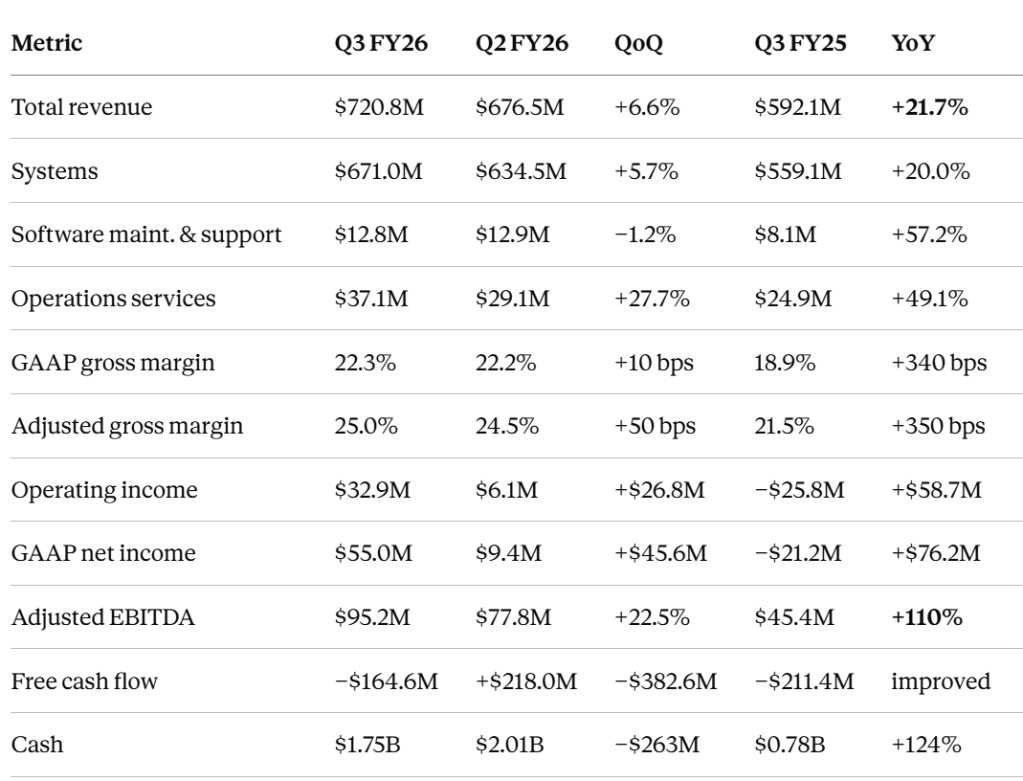
Adjusted EBITDA of $95.2 million beat the company’s $80–85 million guide. Q4 guidance is $760–780 million of revenue and $100–105 million of adjusted EBITDA, putting FY2026 on track for roughly $2.8 billion (+25%) and about $340 million of adjusted EBITDA — versus $2.25 billion and $147 million in FY2025.
The best number in the quarter: adjusted operating expenses grew about 3% year over year against 22% revenue growth. That’s real operating leverage. International revenue also inflected hard, from $7.2 million to $83.5 million, going from 1% to 12% of revenue.
Three qualifiers I’d attach even to the good news:
The $55 million net income is one-third revaluation. Operating income was $32.9 million. The rest is other income — including a $19.4 million non-cash fair-value gain on strategic investments (largely a supplier warrant revaluation) and $11.3 million of interest income. Because of the Up-C structure, only $11.7 million was attributable to common stockholders. Diluted EPS was $0.09.
The warranty line flattered the margin. After a component replacement program and targeted recall in Q2 that carried a $34.3 million liability, the Q3 warranty provision was $266 thousand — against $4.1 million in the year-ago quarter. That’s roughly a $3.9 million year-over-year tailwind sitting inside the gross-margin expansion.
The prior-year base moved. In Q1 FY26 the company changed stock-comp attribution from accelerated to straight-line and applied it retrospectively. Restated, the Q3 FY25 net loss is $21.2 million; under the prior method it was $31.9 million. The celebrated $76 million swing is measured against a comparative that an accounting policy change improved by $10.8 million this year.
And software gross margin is compressing: 79.0% → 73.9% → 72.7% over three quarters. If the recurring layer is supposed to carry the margin story, that’s the wrong direction.
The Walmart Problem – Restated
Walmart makes up 90.5% of SYM’s revenue as of Q3FY2026 and that number has only grown over the past several years. This is a serious customer concentration risk problem. Furthermore:
1. The Walmart contract is cost-plus. Walmart pays the cost of implementation — materials and labor — plus a specified net profit amount, in certain cases subject to a capped cost amount, along with software maintenance for a minimum of 15 years and spare parts. That is not a pricing structure with operating leverage in it. It explains why systems gross margin sits near 22% and it puts a real question mark over the long-term 30%+ systems margin target, because roughly 90% of revenue is earned under a contract designed to pay cost plus a defined profit. Margin expansion has to come from the 10% that isn’t Walmart, or from the recurring layer — whose margin is currently falling.
2. There is a contractual restriction on who else they can sell to. Under the 2022 Walmart MAA, Symbotic agreed to certain restrictions on selling or licensing its products and services to a specified company and its subsidiaries, affiliates, and dedicated service providers. The filing doesn’t name the company. Whoever it is, the “expand into new verticals and win new customers” growth vector has a contractual boundary drawn inside it by the customer who is already 90% of revenue. Walmart also holds board observation rights.
3. The nearest large catalyst is more Walmart. The 2025 Walmart MAA contemplates 400 micro-fulfillment systems if Symbotic satisfies certain performance metrics, which the 10-Q says could add more than $5.0 billion to remaining performance obligations. That is the single biggest upside item in the story, and if it lands, concentration gets worse, not better. The bull case and the bear case are the same counterparty.
And the affiliate customer is the CEO’s own company. C&S Wholesale Grocers is disclosed as a related party and an affiliate because Chairman and CEO Richard Cohen also serves as Executive Chairman of C&S, and he and trusts for his family are its substantial majority stockholders. C&S contracts run through October 2029. C&S revenue in Q3 was $2.4 million — down from $4.8 million a year earlier; $6.4 million for nine months versus $10.0 million.
So the second-most-cited non-Walmart logo is a company the CEO controls, and its revenue contribution is shrinking. That isn’t damning on its own — it’s disclosed, it’s small, and Symbotic’s technology plausibly got its start there. But it does mean the diversification story is thinner than the customer-logo slide implies.
The Backlog Question: Half of It Is a JV Symbiotic Helps Fund
This is the finding that moved me most, and it’s the one I’d never have gotten from a press release.
The 10-K states that backlog includes $11.6 billion associated with GreenBox — now doing business as Exol. The Q3 10-Q confirms $11.6 billion of unsatisfied performance obligations under the Exol contract. Against a total backlog of approximately $22.5 billion, that’s roughly half!
Here is what Exol actually is, per the filings:
– Symbotic Holdings owns 35%; Sunlight Investment Corp. (SoftBank) owns 65%.
– It is a variable interest entity specifically because it lacks sufficient equity to finance its operations without additional subordinated financial support from both Symbotic and SoftBank.
– Symbotic does not consolidate it, because it isn’t the primary beneficiary — it doesn’t control Exol’s board.
– Symbotic’s maximum exposure to loss is $1,491.3 million, of which $1,487.9 million is future funding commitments.
– Symbotic put in $23.4 million of cash in Q3 and $73.2 million over nine months.
– Symbotic recognized $41.1 million of revenue from Exol in Q3 and $130.6 million over nine months.
– Unbilled receivables from the Exol contract went from $0.6 million to $31.3 million over nine months.
– Exol is loss-making. Symbotic’s equity-method losses were **$9.6 million in Q3 and $22.4 million over nine months**, and accelerating.
Put the two cash flows side by side: over nine months, Symbotic recognized $130.6 million of revenue from Exol while contributing $73.2 million of cash into Exol. That’s roughly 56 cents of funding going out for every dollar of revenue coming in.
I just can’t get behind a company whose attributing half their backlog to a company they help finance. What’s more, the backlog actually ticked down QoQ and is not growing. That’s what attracted me to this stock in the first place.
The Unremediated Material Weakness
As of September 27, 2025, management concluded internal control over financial reporting was not effective. Grant Thornton, the auditor, issued an adverse opinion on internal control.
The weakness: the company did not design effective controls over the timing of cost-of-revenue recognition. Because Symbotic recognizes revenue on a cost-to-cost percentage-of-completion basis, cost timing directly drives revenue timing. Get the cost period wrong and the revenue period is wrong with it. Management characterizes the resulting discrepancies as immaterial and says no material misstatement resulted.
Two things make this worse than a one-off:
It’s the second consecutive year, in the same area. The fiscal 2024 material weakness concerned controls over revenue recognition related to non-billable cost overruns on certain deployments. That one was remediated as of September 27, 2025 — and a new weakness in cost and revenue timing appeared in its place.
It is still not fixed. The Q3 FY2026 10-Q states that as of June 27, 2026 the material weakness persists and disclosure controls remain not effective. The remediation plan’s centerpiece — a long-term ERP system to manage vendors and automate goods-and-services receipt — isn’t due until fiscal 2027.
This matters more than usual at this specific company, because percentage-of-completion revenue on multi-year, milestone-billed projects is already the most estimate-dependent revenue model there is. Add a $748 million combined receivable and unbilled-receivable balance that grew from $368 million in nine months, and a control weakness sitting precisely on the timing mechanism, and you have a set of numbers I can’t independently rely on. We already saw a nine-month prior-year cash-flow revision of $58.2 million this quarter, reclassifying ASR-related items from investing to operating — presentation only, no effect on net loss or EPS, but another data point.
Securities Litigation
The company faces a putative securities class action (originally Decker, amended as Traina) in the District of Massachusetts. The claims are against Symbotic and four of its officers, alleging false or misleading statements or omissions about financial results, deployment times, revenue recognition, and internal controls, on behalf of purchasers between November 20, 2023 and February 5, 2025.
The critical development, which I missed entirely until I read the filing: on July 23, 2026 the court granted in part and denied in part the motion to dismiss. The case survives and proceeds. A scheduling conference is set for August 31, 2026. The company says it intends to defend vigorously, cannot estimate a possible loss, and does not believe the outcome will materially affect its financial condition — though it acknowledges the outcome could be material to results in a given period.
Separately, two shareholder derivative actions filed in October 2024 — Austen v. Cohen and Kukreja v. Cohen — assert claims against senior officers and board members including breach of fiduciary duty and unjust enrichment, tied to allegations about information disseminated regarding expected fiscal Q3 2024 earnings.
There’s also a cover-page detail on the 10-K worth noting: both checkboxes are marked — that the financial statements reflect correction of an error to previously issued statements, and that those corrections required a clawback recovery analysis of executive incentive compensation. I could not locate a restatement note inside the fiscal 2025 document, so this likely refers to previously corrected periods rather than something new. But it’s a checkbox most companies never mark.
Note what these allegations are about. Not a product failure. Not a bad quarter. Revenue recognition, deployment times, and internal controls — the exact three areas where the company has independently disclosed an unremediated control weakness. The litigation and the control problem are not two separate risks. They’re one risk with two disclosures.
Why I’m No Longer Interested
1. 90.5% single-customer concentration, rising, on a cost-plus contract with capped costs, plus a contractual restriction on selling to a specified competitor. That’s a structural ceiling on both diversification and margin.
2. Half the backlog is with a JV that can’t fund itself and that Symbotic is committed to fund up to ~$1.5 billion. Not improper — but not the arm’s-length order book the headline ratio implies.
3. Backlog flat for a year while the coverage ratio decays by arithmetic.
4. An unremediated material weakness on revenue-timing controls, with an adverse auditor opinion, on a percentage-of-completion business with a $748 million receivable balance, not scheduled for full remediation until fiscal 2027.
5. A surviving securities class action about revenue recognition and internal controls, alongside derivative actions against the CEO and board.
Items 4 and 5 are the ones that actually settle it. My screens assess business quality, and a business whose auditor says its financial reporting controls are not effective — in the specific area that determines when revenue is recognized — cannot pass a quality screen at any price. Buying it cheaper doesn’t make the numbers more reliable. It just means I’d own an uncertain set of figures at a discount, which is not the same thing as a margin of safety.
What Would Bring Me Back
Remediation of the material weakness, confirmed by the auditor over a full cycle. Customer concentration trending back down on the strength of non-Walmart, non-Exol revenue. Backlog growing again on arm’s-length orders. Resolution of the litigation. That’s a real path, not a polite brush-off — and if the company walks it, I’d rather buy a proven business at a higher price than an unproven one at this one.
Disclaimer: I do not own shares of SYM. This post reflects my personal opinions and analysis for informational purposes only. It is not financial, investment, or tax advice, and it is not a recommendation to buy or sell any security. All factual statements about Symbotic are drawn from its Form 10-K for the fiscal year ended September 27, 2025 and its Form 10-Q for the fiscal quarter ended June 27, 2026, as filed with the SEC. Legal claims described are allegations that have not been adjudicated, and the company has stated it intends to defend against them. Figures are current as of August 6, 2026 and may be out of date by the time you read this. Do your own research and consult a licensed professional before investing.


Leave a Reply