Biz Overview
Texas Pacific Land Corporation (TPL) is probably the fastest growing O&G stock that doesn’t produce a drop of oil. They own land from which they derive royalties from oil, gas, and NGL production (57% of 2023 revenues) as well as produced water (18%), easements and surface leases (11%) and land sales (1%). They own approximately 868,000 surface acres in WTX which were previously owned by the Texas and Pacific Railway Company who was granted land by the government to incentivize rail infrastructure expansion.
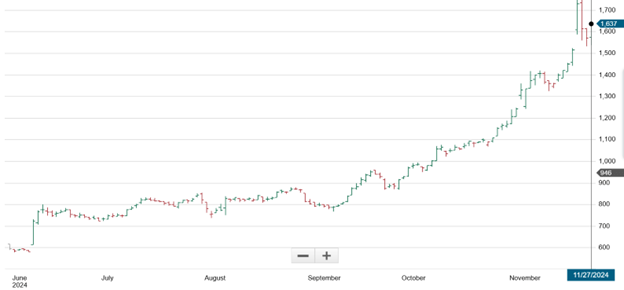
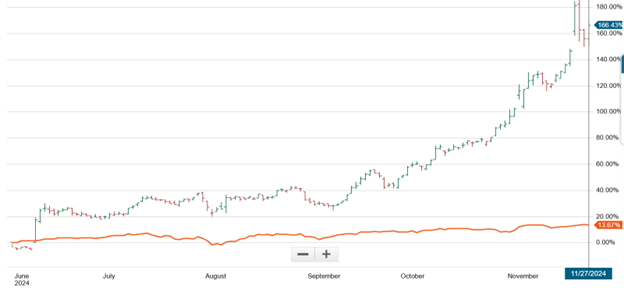
In the two graphs below you can see how TPL’s stock price has appreciated over the past year and has outperformed the S&P 500 (which they are expected to join in the next year) by a wide margin. In this blog I’ll talk more about what’s driving this and call out some price targets and risks.
Growth and Operational Efficiency
TPL’s asset is land ownership and mineral rights. Oil & gas companies lease their land and pay a portion of their revenues to TPL in the form of royalties. TPL spends very little capital to maintain their asset and in turn receives royalties which are quickly turned into cash as there is no inventory and they have no debt to repay. Their cash conversion and return on assets and equity is otherworldly and they have been consistently carrying a heavy, growing cash balance every year. At the end of 2023 they held $725MM in cash.
Looking at profitability metrics:
- Gross profit margins: 93.6%
- Net profit margins: 65%
- Return on assets: 39.8%
- Return on equity: 44.5%
- Total debt: 0
No matter who you compare against, these are impressive operational metrics.
Moat and Competitors
Their moat is quite obvious – they own 868,000 surface acres in the Permian is the most productive oil, gas, and NGL plays in the country. Oil half-cycle break evens are extremely low and there is ample infrastructure to move product and if there isn’t sufficient pipeline, well, it is TX so building or expanding pipe is not really a bottleneck. Second, TX export infrastructure continues to grow so even if there is lack of demand in the U.S., export markets are a safe outlet. Lastly, WTX irradiation is also amongst the best in the country so TPL could hedge their oil royalties with solar capacity buildout.
I briefly looked up other similar “trusts” and came up with several including:
- Permian Basin Royalty Trust (PBT)
- Sabine Royalty Trust (SBR)
- North European Oil Royalty Trust (NRT)
- San Basin Royalty Trust (SJT)
- Cross Timbers Royalty Trust (CRT)
- VOC Energy Trust (VOC)
If any turn out to be interesting I’ll follow up in another blog, but just sharing these for the intrigued reader.
Risks and Opportunities
The risks are quite low for a non-operating company. The biggest risk is a collapse in oil prices but even a collapse in oil prices would be brief. The U.S. is now a large exporter of all these commodities and under Trump we’re likely to see few restrictions, if any, on exporting these products. Lack of infrastructure could constrain growth, but this is TX we’re talking about, and constructing supporting infrastructure (gas processing plants, fractionators, pipelines, etc.) is unlikely to be a significant barrier to growth.
Weather could be a factor but likely only short-lived. It is not uncommon now for WTX to experience arctic-like temperatures that cause well head freeze-offs, but those are only a blip on the radar at worst.
Given the abundance of supply in the Permian and relatively weak natural gas prices, I could see a scenario where data centers and accompanying gas-fired power plants get developed in this region. AI is driving exponential need for data centers and clean energy and the Permian produces an astounding amount of natural gas which, if paired with carbon capture, could be a perceived as both a sustainable and cost-effective energy production pathway. TPL could directly benefit from this trend directly through its surface and easements leases or indirectly through increased production of natural gas.
Sustained Alpha and Valuation
A growth rate is difficult to project here because they haven’t really spent any capital expanding their asset base.
Based on today’s current price and a discounted cash flow model we can infer the market is assuming the following on TPL :
- Discount rate: 7% (10-year treasuries are ~ 4.2% so I added a small risk premium which is inline with many real estate companies who act as lessors)
- FCF of $415MM growing annually 11%-12% with a terminal growth rate of 5%
- Annual cash on balance of $600MM
- Assuming 23MM outstanding shares with no future dilution or incremental dividends paid
- 0 debt
Of course, these are just assumptions but the two things I see with most variability with would be the assumed annual cash on hand and the growth rates. Based on historical company operating data and what we know about the business (and ignoring drilling rig counts and oil & gas prices) I believe these are very conservative assumptions. Let’s look a slightly more optimistic scenario to estimate what this stock could be worth.
Assume the following:
- Discount rate: 7%
- FCF of $415MM growing annually over 10 years at 20% with a terminal growth rate of 5%
- Historically the CAGR of their FCF over the past 8 years is 34% with the past two years at 22%
- Annual cash balance of $700MM
- Assuming 23MM outstanding shares with no future dilution or increase in dividend payout ratio
- 0 debt
We get a price of $3,367/share.
Taking the last set of assumptions and now estimating 30% growth, we get $6,709/share.
Assuming these assumptions hold, these represent possible price targets over the next 1-3 years.
 Quantum Yields
Leave a comment